
Mubite's new Nitro Challenge lets you start a one-step challenge on any account up to $100,000 for just $19.90. Here is how the new challenge works.
September CPI came in hot on October 14, pushing core inflation to 2.6% and knocking Bitcoin to a one-month low near $80,650. Here is why one data point reset the rate-cut trade.
Ethereum's Glamsterdam upgrade went live on the Sepolia testnet on October 6, rewiring how blocks get built with ePBS. Here is what it changes for traders and why mainnet is still months out.
All information on this site is provided by Mubite for educational purposes only, specifically related to financial market trading. It is not intended as an investment recommendation, business advice, investment opportunity analysis, or any form of general guidance on trading investment instruments. Trading in financial markets involves significant risk, and you should not invest more than you can afford to lose. Mubite does not offer any investment services as defined under the Capital Market Undertakings Act No. 256/2004 Coll. The content on this site is not directed toward residents in any country or jurisdiction where such information or use would violate local laws or regulations. Mubite is not a brokerage and does not accept deposits. All trading accounts provided by Mubite are simulated demo accounts using live market data. No client funds are traded on live markets. Payout figures shown are individual results and are not typical. Past performance does not guarantee future results.
Mubite s.r.o., Školská 660/3, Nové Město, ICO: 23221551 Praha 1, 110 00, Czech Republic | Copyright Ⓒ 2026 Mubite. All Rights Reserved.
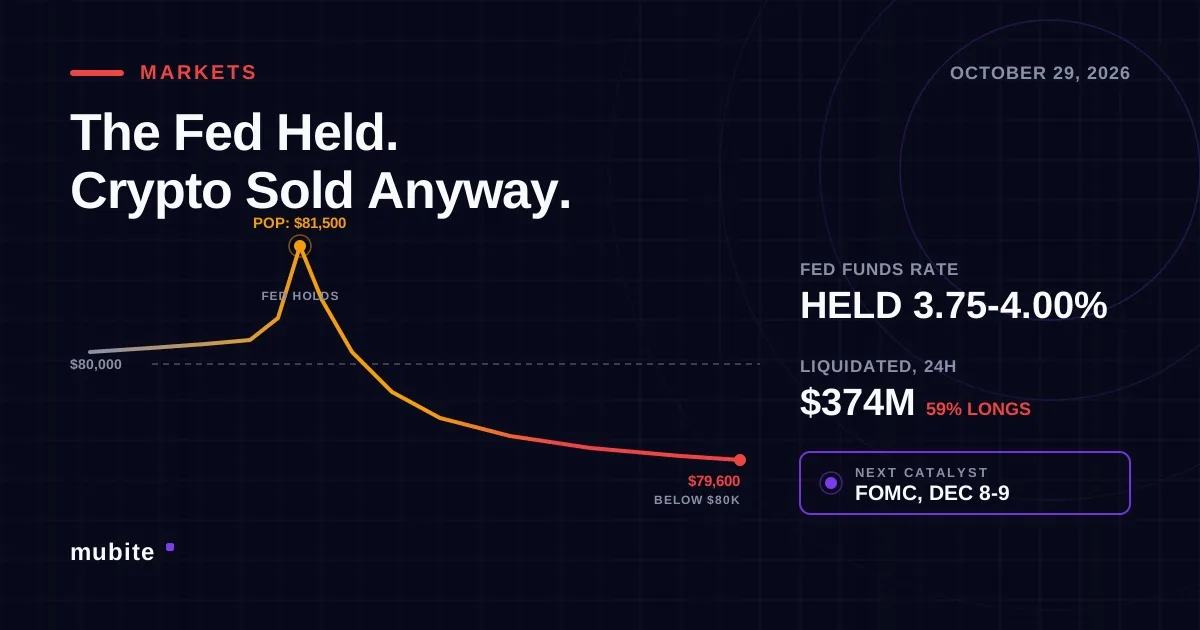
The Fed held rates at 3.75% to 4.00% on October 28 in a 10-2 vote, with both dissents wanting a hike. Bitcoin popped above $81,500, then fell below $80,000.
Three days ago we wrote that Bitcoin had compressed into a tight range and that the Federal Reserve, not the order book, would decide which way it broke. The decision is in. On October 28 the Fed left rates unchanged at 3.75% to 4.00%, Bitcoin briefly popped above $81,500 on the headline, and within hours it was back below $80,000, trading near $79,600. A hold is supposed to be the neutral outcome. This one was not. The way the Fed held, and the way the market sold the relief rally, tell you the tiebreaker came down on the hawkish side.
The headline number did not change. Everything around it did.
The Federal Open Market Committee kept the federal funds target range at 3.75% to 4.00%, where it has sat since September's quarter-point hike. The vote was 10 to 2, and the detail that matters is the direction of the dissent. Governor Lisa Cook and Cleveland Fed President Beth Hammack both dissented in favour of raising rates another quarter point, not cutting them. When the only disagreement on a committee is whether to tighten further, a hold is not a pause on the way to easing. It is the floor of a debate about going higher.
Chair Kevin Warsh reinforced that read in the press conference. The statement upgraded its description of economic activity from "solid" to "strong," noted that inflation "remains elevated," and leaned on incoming data to guide the next move. Warsh said the economy was "not running too hot" and, critically, made no commitment to a cut at the next meeting on December 8 and 9. For a market that had spent weeks positioning for rate relief, that absence was the whole message.
A rate hold only supports risk assets if the market reads it as the step before a cut. This one read as the opposite.
From the data we have analysed across rate-sensitive sessions this year, crypto trades as the highest-beta expression of the liquidity trade. It rallies hardest when cheaper money looks imminent and unwinds hardest when that expectation is pushed out. Warsh did not push the market toward a December cut. He described a strong economy with elevated inflation and a committee whose dissenters want to tighten.
That combination moves the expected path of policy higher for longer, which is the single least friendly backdrop for leveraged crypto positioning. The market did not sell because the Fed did something hostile. It sold because the Fed declined to offer the dovish signal that the recovery had been built on.
The price action around the decision is a textbook example of the trap both of our recent pieces warned about.
Bitcoin spiked above $81,500 in the immediate reaction, the kind of knee-jerk pop that pulls in late longs chasing a breakout. It did not hold. Within hours the move had fully reversed, Bitcoin lost the $80,000 level it had defended for two weeks, and it printed a session low near $79,600. The first move after a major macro event is frequently the fake one, and traders who sized up on the initial spike were the first to be flushed.
The liquidation data shows the damage:
Roughly $374 million in total liquidations across the crypto market over 24 hours, hitting more than 84,000 traders
Long positions accounted for about 59% of that, around $219 million, against $155 million in shorts
Bitcoin liquidations came to $97 million and Ethereum to $82 million
The single largest liquidation was a $6.53 million Ethereum position on Binance
The rest of the majors fell harder than Bitcoin. Ethereum dropped about 2.1% to $2,303, XRP lost roughly 3% to $1.29, and total crypto market capitalisation slipped 1.4% to around $2.80 trillion. When the whole board moves together to the downside on a macro print, correlation is doing the work, and diversification across tokens offers no protection.
For anyone carrying leverage into the event, the mechanics are the lesson. Knowing your liquidation price before a scheduled catalyst, not after, is the difference between riding the reversal and being the reversal. The same goes for funding rates, which reset violently when a crowded relief trade flips within a single session.
The two-week range broke to the downside, and the Fed just removed the most likely catalyst for reclaiming it quickly.
With a December cut no longer a safe assumption, the higher-for-longer backdrop stays in place for at least another six weeks, until the December 8 and 9 meeting. Prediction-market traders had already been pricing meaningful odds of a touch of $78,000 before month-end, and losing the $80,000 floor on a hawkish hold puts that level firmly back in play.
The structure now is a market that failed at resistance, lost its two-week support, and has no obvious macro relief on the calendar until December. That does not guarantee lower prices, markets can and do rally against a hawkish Fed, but it removes the specific tailwind the recovery was leaning on.
Share it with your community